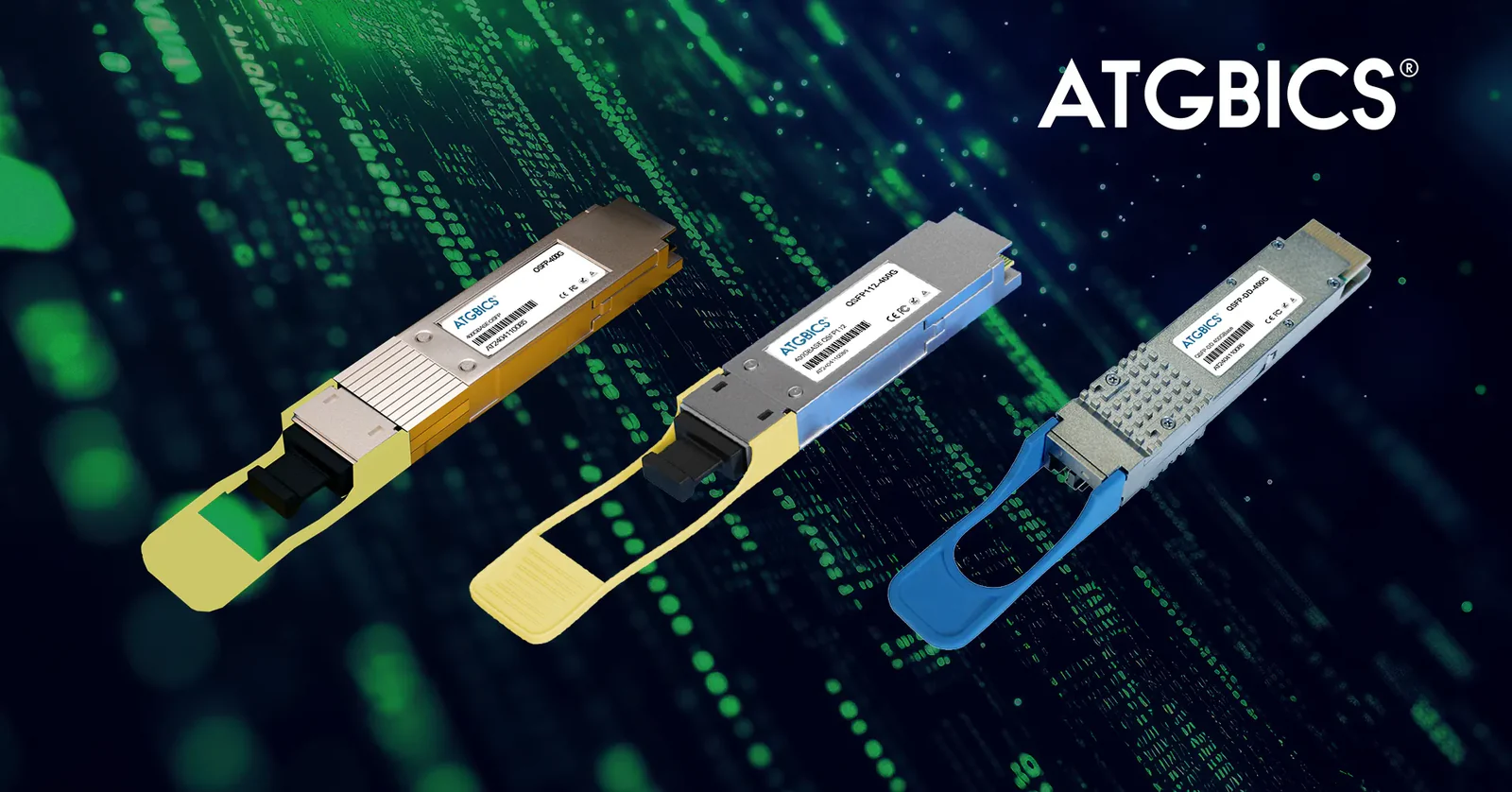
The continued growth of generative artificial intelligence, cloud computing, and large-scale model training has pushed data center interconnect bandwidth demands to unprecedented levels. As a result, 400G Ethernet is being deployed on a massive scale in hyperscale data centers, enterprise data centers, and AI computing clusters. At the heart of this shift lies the 400G QSFP-DD (Quad Small Form Factor Pluggable Dual Density) transceiver—a compact, high-density optical module that has rapidly become the industry’s preferred 400 Gbps connectivity package.
However, choosing the right 400G QSFP-DD transceiver is no easy task. Incorrect architectural decisions can easily result in unnecessary losses exceeding $50,000. Choosing the wrong transceiver type can lead to insufficient bandwidth, excessive power consumption, inefficient upgrades, and difficulty scaling to 800G. This article aims to dispel confusion by analyzing four mainstream 400G QSFP-DD transceiver types (SR8, DR4, FR4, and LR4) and the cabling solutions that enable 400G data center networks.
Understanding the QSFP-DD Advantage
The QSFP-DD form factor increases the number of electrical lanes from four (on traditional QSFP28) to eight, delivering four times the bandwidth—400 Gbps—without enlarging the switch front-panel footprint. It uses eight 50 Gbps electrical lanes with PAM4 modulation, achieving an aggregate bandwidth of 400 Gbps. Backward compatibility is a key advantage: QSFP-DD ports support legacy QSFP28, QSFP+, and QSFP modules, allowing data centers to phase in 400G capacity while maintaining existing 100G infrastructure.
PAM4 (Pulse Amplitude Modulation with four levels) encodes two bits per symbol (“00,” “01,” “10,” “11”), effectively doubling the data rate without increasing the baud rate. However, this comes with higher DSP requirements and stronger forward error correction demands.
The Four Main 400G QSFP-DD Transceiver Types
400G SR8: Short-Reach Multimode
The 400G SR8 transceiver is designed for short-reach interconnects within a single data center row or rack. It uses eight parallel multimode lanes (50 Gbps PAM4 per lane) and requires an MPO-16 connector with 16 fibers—eight for transmit and eight for receive. Typical reach is up to 100 meters over OM4 or OM5 multimode fiber. With power consumption ranging from 10W to 12W, the SR8 is suitable for leaf-spine connections within the same row, though its high fiber count can strain cable management.
400G DR4: 500-Meter Single-Mode
The 400G DR4 transceiver represents a significant evolution toward single-mode parallel optics. It uses four parallel lanes, each operating at 100 Gbps PAM4, delivering 400 Gbps aggregate over a single 12-fiber MPO-12 connector (four transmit, four receive, four unused). Designed for up to 500 meters over single-mode fiber (SMF), the DR4 consumes between 9W and 12W. It is an excellent choice for intra-building connections and breakouts to 4×100G.
400G FR4: The Campus Workhorse
For medium-distance interconnects up to 2 kilometers, the 400G FR4 (or 400GBASE-FR4 QSFP-DD) has emerged as the dominant single-mode solution. The “FR4” designator stands for “four wavelengths”—the module multiplexes four 100G PAM4 optical lanes onto a single duplex LC fiber using CWDM wavelengths: 1271 nm, 1291 nm, 1311 nm, and 1331 nm.
This CWDM4 approach offers a critical advantage over parallel optics: it leverages existing duplex LC cabling infrastructure deployed for legacy 10G, 25G, and 100G networks. Data centers that already use duplex SMF for 100G connections can upgrade to 400G by simply swapping transceivers—no new fiber plant required. The 400G FR4 typically consumes between 7W and 10W, with silicon-photonics variants reaching as low as 7W. It is ideal for leaf-spine interconnects within data center campuses, cloud platforms, and AI compute clusters requiring high-speed 400G connectivity.
400G LR4: Long-Haul Connectivity
At the top end, the 400G LR4 transceiver extends reach to 10 kilometers over duplex single-mode fiber using the same four-wavelength CWDM approach. However, longer reach demands more optical power. LR4 modules consume between 12W and 14W, and they require cleaner fiber plants with lower splice and connector losses. These are best reserved for inter-data center links or campus backbones where FR4’s 2 km reach is insufficient.
Cabling Solutions for 400G Deployments
Point-to-Point Direct Connections
The simplest cabling scheme is direct point-to-point: a 400G QSFP-DD module on one switch connects directly to another 400G QSFP-DD on a neighboring switch using a single fiber cable. For 400G FR4, this means a single duplex LC patch cord between two switches located up to 2 km apart. This approach minimizes latency and is ideal for spine-leaf fabrics within the same data center hall.
Breakout Cabling: 400G to 4×100G
Breakout cables provide an elegant migration path for data centers transitioning from 100G to 400G. A single 400G QSFP-DD port can be split into four independent 100G connections, allowing a modern 400G spine switch to connect to existing 100G-capable leaf switches or servers without replacing endpoint hardware.
The electrical lane mapping is straightforward: a QSFP-DD port uses eight 50 Gbps PAM4 lanes. Breakout cables assign two lanes (TX1/RX1 and TX2/RX2) to each of four output connectors, creating four 100G links. A 400GBASE-DR4 module with an MPO-12 connector can break out to four 100GBASE-DR QSFP28 modules using a 16-fiber MPO to 4×LC Duplex breakout cable.
This breakout capability—often called “fan-out”—delivers substantial cost savings. One real-world case study showed that using QSFP-DD breakout cables allowed a cloud provider to upgrade its core switches to 400G while retaining 800 existing 100G servers, completing the migration in three weeks with zero service disruption and total cable costs under $50,000, compared to a $2.4 million full endpoint replacement.
Structured Cabling with MPO/MTP Trunks
For high-density deployments, structured cabling using MPO/MTP trunk cables offers superior cable management and scalability. A 400G QSFP-DD DR4 module with an MPO-12 interface can connect to an MPO-12 trunk, which terminates at a patch panel housing cassettes that fan out to individual LC duplex ports. This architecture supports both point-to-point 400G connections and breakout configurations, making it suitable for large-scale leaf-spine fabrics.
Power and Thermal Considerations
One often-overlooked aspect of 400G deployment is power consumption. A fully loaded 400G switch populated with high-power LR4 modules can draw significantly more power than its 100G predecessor. Standard 400G QSFP-DD modules consume between 10W and 14W under normal operating conditions, compared to roughly 4W for a 100G QSFP28.
The good news is that newer-generation modules are more efficient. Silicon-photonics-based 400G FR4 variants consume as little as 7W—a 30 percent reduction from first-generation designs. However, data center operators must still account for this increased thermal load when planning cooling capacity and switch slot power budgets.
Choosing the Right 400G QSFP-DD Transceiver
The correct transceiver choice depends on three factors: distance, existing cabling, and future upgrade plans.
For intra-rack connections under 100 meters with multimode fiber available, 400G SR8 is cost-effective.
For intra-building connections up to 500 meters over single-mode fiber, 400G DR4 provides an excellent balance of reach and power efficiency, with clean breakout to 4×100G.
For campus-scale connections up to 2 km over existing duplex single-mode fiber, the 400G FR4 or 400GBASE-FR4 QSFP-DD is the proven, widely deployed solution.
For inter-building or metro connections up to 10 km, 400G LR4 is the appropriate choice, though at higher power and cost.
Conclusion
Deploying 400G in the data center requires a clear understanding of both transceiver types and cabling architectures. The 400G QSFP-DD platform offers the density, backward compatibility, and performance needed for next-generation networks. Among the available optics, the 400G FR4 stands out as the workhorse for campus interconnects, leveraging existing duplex LC infrastructure to deliver 2 km reach with excellent power efficiency.
Breakout cables provide a pragmatic migration path from 100G to 400G, protecting existing investments in endpoint equipment while enabling higher spine bandwidth. Whether you choose point-to-point direct connections, breakout cabling, or structured MPO trunking, the key is to align your transceiver selection with your actual distance requirements and fiber plant capabilities. With careful planning, 400G QSFP-DD deployment can be both high-performance and cost-effective—delivering the bandwidth that modern AI and cloud workloads demand without unnecessary infrastructure overhauls.
Stay in touch to get more updates & news on The Tech Norozen!