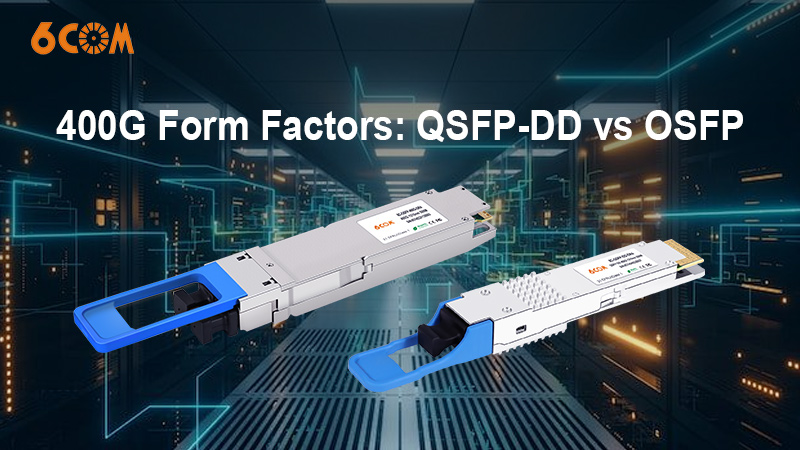
As global data traffic skyrockets with AI workloads, 5G expansion, and cloud-scale services, modern data centers demand faster, denser, and more power-efficient connectivity. To keep up with this rapidly growing need, network engineers and hardware vendors are turning to QSFP-DD transceivers as the backbone of 400G and even 800G networks. This form factor combines high bandwidth, compact design, and backward compatibility—making it the cornerstone of next-generation optical communication systems.
The Evolution from QSFP to QSFP-DD
To appreciate why QSFP-DD is revolutionary, it helps to understand its lineage. The “QSFP” (Quad Small Form-Factor Pluggable) transceiver family began as a compact solution offering four lanes of data transmission. Early generations such as QSFP+ (40G) and QSFP28 (100G) established themselves as the standard for Ethernet and InfiniBand links across data centers and telecom networks.
QSFP-DD—short for Quad Small Form-Factor Pluggable Double Density—builds on that foundation by doubling the number of electrical lanes from four to eight. Each lane supports 25 or 50 Gbps, enabling total throughput of up to 200G or 400G in a single module. This density improvement allows network architects to scale bandwidth without expanding physical space or increasing cable complexity.
Key Design Features and Benefits
One of the biggest advantages of the QSFP-DD form factor is port density. Traditional chassis and switches can support twice as many QSFP-DD ports compared to CFP or CXP modules, dramatically increasing per-rack capacity. Moreover, QSFP-DD retains backward compatibility with existing QSFP28 and QSFP56 hardware. That means you can insert legacy modules into QSFP-DD ports, protecting prior investments while easing the transition to higher speeds.
Electrically, QSFP-DD connectors use an expanded 76-pin layout that supports the eight-lane interface while maintaining the same mechanical dimensions as QSFP modules. This thoughtful design lets equipment vendors reuse current thermal and mechanical infrastructures with minimal modification.
Thermal performance is another critical design focus. With power consumption typically ranging from 7 to 14 watts depending on the optical specification, QSFP-DD modules employ advanced heat-sinking materials and airflow management to maintain stability under continuous high-load operation.
Understanding Different 400G Variants
QSFP-DD modules come in several optical types, distinguished by reach (distance), fiber type, and protocol. Common variants include SR8, DR4, FR4, and LR4.
- 400G QSFP-DD SR8: Designed for short-reach multimode fiber (MMF) links, typically up to 100 meters, using eight parallel 50G lanes.
- 400G QSFP-DD DR4: Suited for longer single-mode fiber (SMF) runs up to 500 meters, using four parallel 100G PAM4 lanes.
- 400G QSFP-DD FR4: Supports transmission up to 2 kilometers over SMF by multiplexing four wavelengths onto a single pair of fibers. This module has become one of the most popular solutions in modern 400G leaf-spine and data center interconnect applications.
- 400G QSFP-DD LR4: Provides even longer reach—typically up to 10 kilometers—for campus networks or metro connections.
Because the 400G QSFP-DD FR4 offers an ideal balance of distance, cost, and power efficiency, it has rapidly become the mainstream choice for high-bandwidth intra-data-center connections. Using CWDM (Coarse Wavelength Division Multiplexing) technology, it transmits four optical channels in the range of 1270 nm to 1330 nm and converts them into eight electrical 50G PAM4 lanes on the host side. This makes it a reliable solution for large-scale cloud providers and hyperscale data centers aiming to optimize both capital and operational expenditure.
Technology Behind the Performance
QSFP-DD modules leverage PAM4 (Pulse Amplitude Modulation) encoding, which allows twice the data rate per lane compared to non-return-to-zero (NRZ) signaling used in earlier generations. By encoding four distinct amplitude levels, PAM4 transmits two bits per symbol, boosting capacity without doubling physical connections. However, this technique introduces increased signal noise sensitivity, requiring advanced DSP (digital signal processing) chips and equalization to maintain link integrity.
Optical alignment and packaging have also advanced considerably. QSFP-DD modules often use integrated laser and photodiode arrays structured with silicon photonics or EML (Electro-Absorption Modulated Laser) technology for improved power efficiency and reduced component footprint. Many designs adopt pluggable cooling techniques or direct-touch heatsinks to cope with the high heat density of dense rack environments.
Applications Across Modern Networks
QSFP-DD transceivers aren’t just limited to data center use—they’re rapidly expanding into telecom and enterprise domains as well. Let’s look at a few key deployment scenarios:
- Cloud and Hyperscale Data Centers: As AI-driven workloads and distributed storage clusters multiply, cloud operators need massive east-west bandwidth within their fabrics. 400G QSFP-DD modules connect top-of-rack switches to spine layers with minimal latency.
- 5G Transport Networks: The rollout of 5G demands equally fast fronthaul, midhaul, and backhaul links. Compact, low-power QSFP-DD transceivers perfectly match the high-capacity needs of 5G aggregation layers.
- Inter-Data Center Connectivity: For campus or regional links, long-reach QSFP-DD LR4 or coherent modules can bridge sites across distances of up to 40 km or more.
- High-Performance Computing (HPC): With workloads relying on ultra-fast, low-latency interconnects, the QSFP-DD family helps supercomputing systems manage massive parallel data flows efficiently.
The Role of QSFP-DD in the 800G Era
Even as QSFP-DD dominates 400G deployments, it’s paving the way for 800G migration. The same form factor supports QSFP-DD800, which doubles per-lane speed to 100G PAM4. This roadmap allows equipment vendors to reuse existing mechanical designs while scaling electrical performance through improved signal integrity and new host ASICs.
The transition from 400G to 800G won’t eliminate the need for current modules. Instead, hybrid environments will flourish, with 400G QSFP-DD remaining a workhorse for aggregation and access layers while 800G modules serve the core.
Practical Considerations in Deployment
When selecting QSFP-DD optics, factors like fiber type, link distance, network topology, and total cost of ownership all come into play. Operators must also evaluate transceiver compatibility with switch ASICs and line card interfaces, which can vary slightly between vendors.
Infrastructure preparation is equally critical. Supporting 400G and higher signals means ensuring clean fiber terminations, precise polarity, and high-quality MPO/MTP cabling. Power budgets and cooling systems should also be evaluated, as multiple densely packed high-power modules can increase rack thermal load significantly.
Conclusion
The QSFP-DD form factor represents a major leap in data center and telecom networking efficiency. Delivering up to 400G per port while maintaining backward compatibility, it provides a future-proof foundation for scaling to the terabit era. Among the many variants, the 400G QSFP-DD FR4 stands out as a practical, versatile, and cost-effective choice—offering long-distance reach, reduced fiber complexity, and reasonable power consumption for next-generation data center interconnects.
As computing, AI, and edge infrastructure keep evolving, QSFP-DD optics will remain a central piece of network modernization. They bridge high-bandwidth demand with physical and economic realities—bringing performance that matches the pace of the world’s growing digital ambitions.
Stay in touch to get more updates & news on The Tech Norozen!