Let us settle the question first: the space above your kitchen cabinets is not a shelf, and it is not a storage cupboard you forgot to close. It is a design layer — a strip of wall between the top of the cabinets and the ceiling that can either finish the room or ruin it, depending entirely on how you treat it. Done well, a few considered pieces make the kitchen feel taller, warmer, and more intentional. Done badly, it becomes the dusty graveyard of fake ivy, mismatched baskets, and things that had nowhere else to go.
The difference between the two is not money and it is not taste. It is restraint. The kitchens that get this right all follow the same handful of rules, and the kitchens that get it wrong all break them in the same predictable ways. Once you know the rules, the space above your cabinets stops being awkward and starts being the easiest win in the room.
The Gap Above the Cabinets Is Not a Storage Shelf
The most common mistake is treating the top of the cabinets like a cupboard you are trying to disguise. That is how you end up with a row of baskets that do not match, a dusty artificial plant, and three cookbooks you never open — a collection that says storage, not style. From the floor, the eye reads the whole strip at once, so every item up there is part of one composition whether you planned it that way or not.
Think of it like a picture frame instead. A frame holds a small number of things that belong together, with space around them, and the empty space is part of the design. If the strip above your cabinets is deep enough to notice and empty enough to feel stark, decorating can help. If your cabinets nearly touch the ceiling, or the kitchen already has a lot of pattern and open shelving, the honest answer is often to leave it completely alone.
What Makes Above-Cabinet Decor Look Cluttered
Clutter up there has a specific look, and it is not about how many things you own. It is about scale, colour, and connection. Small objects read as visual noise from floor level — a dozen little ornaments become a fussy, busy line that draws the eye for the wrong reasons. Objects that share nothing with the rest of the kitchen look like they landed there by accident. And a strip that is filled edge to edge, with no breathing room at all, feels top-heavy and makes the ceiling look lower than it is.
The fix is the opposite of what most people do. Instead of adding more small things to fill the gap, use fewer, larger pieces. Instead of introducing a new colour, repeat a finish that already exists in the room. And instead of filling every inch, leave at least a third of the strip completely empty. Negative space is not wasted space — it is what makes the pieces you do place look deliberate instead of dumped.
The Fewer, Larger Rule (and Why It Works)
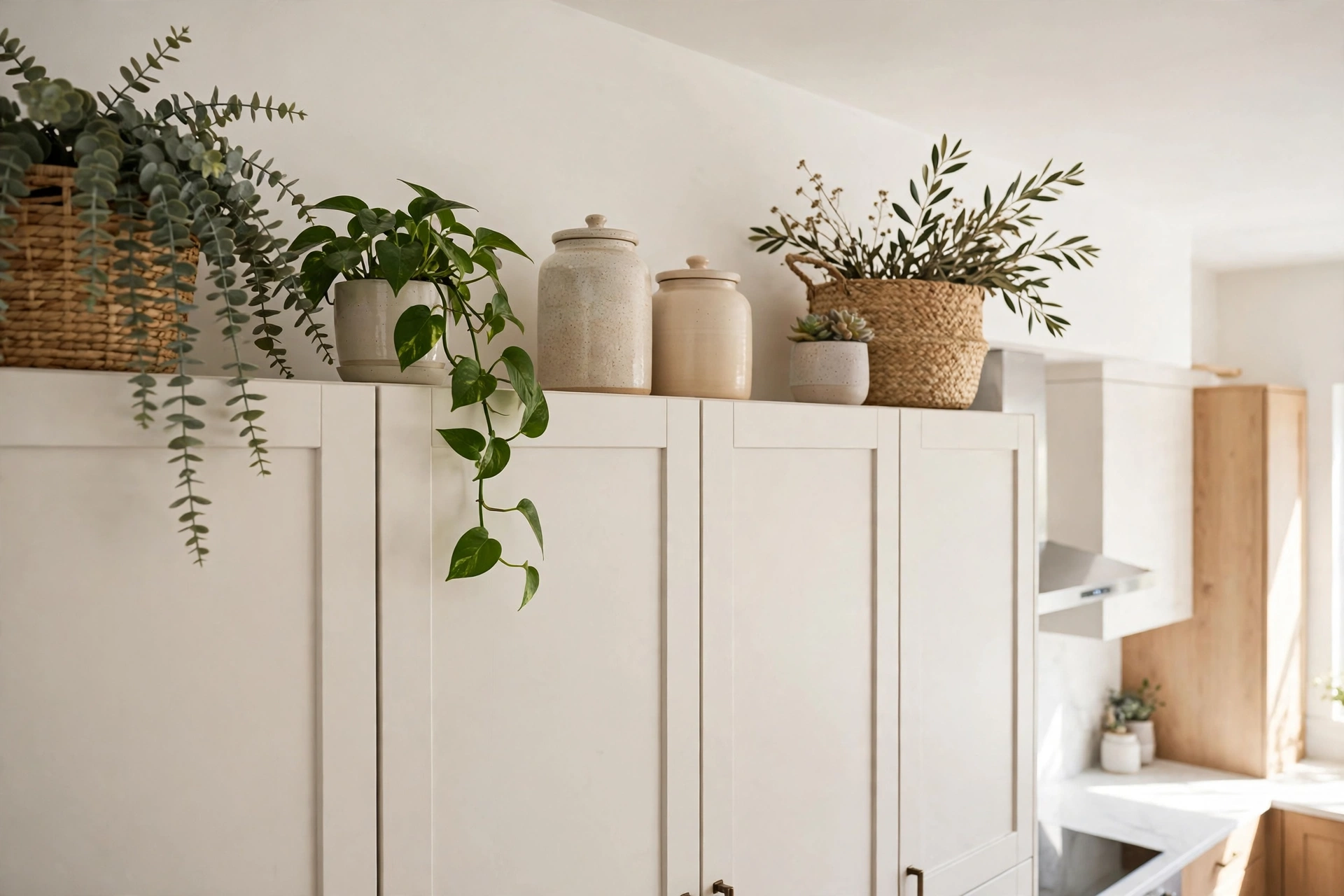
If you remember one thing from this article, make it this: above the cabinets, bigger is better and fewer is better. A large vase, an oversized cutting board, or a substantial basket reads clearly from across the room. A cluster of small trinkets does not read at all — it just looks busy. Group your pieces in twos or threes, vary the heights slightly, and let each group have empty space on either side.
- Go as large as the gap allows. A piece that fills two-thirds of the vertical gap looks intentional. A piece that fills a quarter of it looks lost.
- Group in odd numbers. Two or three pieces together feel composed. Four or five in a row start to look like a shop display.
- Vary the heights, but not wildly. A tall piece, a medium piece, and a low wide piece make a pleasing skyline. Three pieces the same height make a fence.
- Repeat a material from the room. Warm wood if your stools are wood, matte black if your hardware is black, white pottery if your backsplash is white. Echoing a finish ties the whole strip to the kitchen below.
- Keep the palette to two or three colours. One main colour, one accent, and the natural tone of the material. Anything more starts to compete with the kitchen itself.
- Leave a third of the strip empty. The blank stretch is what tells the eye the rest is on purpose. A fully filled strip looks like storage, however pretty the pieces are.
Try it before you commit to anything. Set three large pieces on top of the cabinets, step back to the far side of the room, and look. Then try five small ones and look again. The difference is immediate, and once you have seen it, you will never go back to small things up there.
Seven Looks That Work in Real Kitchens
You do not need a designer to choose a direction — you need a direction. Pick one of these looks, commit to it, and let it decide what goes up there and what stays in the shop. Mixing three directions at once is how the strip ends up looking like a jumble sale.
| Style | What goes up there | Palette |
|---|---|---|
| Natural and organic | Trailing plant, woven baskets, wooden boards | Greens, warm wood, cream |
| Vintage and collected | Old crocks, enamelware, worn timber pieces | Muted whites, soft blues, aged metal |
| Clean and minimal | Two sculptural vases, one framed print | White, black, one natural tone |
| Warm and rustic | Large baskets, copper pots, wooden bowls | Copper, honey wood, cream |
| Modern and graphic | Matte black vessels, clear glass bottles | Black, clear glass, white |
| Coastal and light | Pale ceramics, driftwood, woven trays | White, sand, soft blue |
| Practical and pretty | Matching storage baskets, labelled jars | One colour, repeated exactly |
The practical-and-pretty row deserves a note, because it is the one people get wrong most often. Storage baskets above cabinets work only when they match each other exactly — same size, same colour, same material — and only when there are few of them. Five identical baskets look like a system. Five different baskets look like you ran out of cupboard space, which is exactly the impression you are trying to avoid.
How to Style One Vignette in an Afternoon
A vignette is just a small, deliberate arrangement — and one good vignette is worth more than a whole strip of random objects. If your cabinets run the length of the kitchen, you do not need to decorate the whole run. One or two vignettes, with empty space between them, will look far more considered than a continuous display.
Clear everything off the top of the cabinets and wipe the surface down. Start from zero, not from what is already up there.
Choose your direction from the table above and pick three pieces that fit it — one tall, one medium, and one low and wide.
Place the tallest piece first, roughly a third of the way along the run, not dead centre. Off-centre looks natural; centred looks like a mantelpiece.
Add the medium piece beside it, slightly forward, and the low piece on the other side. Step back and check the silhouette from the far side of the room.
Remove one thing. Whatever you think is the weakest piece, take it away. Almost every vignette improves when something is removed.
Live with it for a week before adding anything else. If the strip still feels empty after a week, add one more piece — not three.
That fifth step is the one people skip, and it is the one that matters most. Editing is the whole skill. Anyone can put things on top of a cabinet; knowing when to stop is what makes it look like a designer was involved.
Lighting, Dust, and the Practical Stuff Nobody Mentions
Here is the part the decorating articles usually skip: the top of a kitchen cabinet is a dust trap, and anything you put up there will need cleaning. The simplest trick costs almost nothing — lay a sheet of wax paper flat across the cabinet top before you place anything on it. It catches the rising grease and dust, and when it looks grubby you lift it off and lay a fresh sheet. It takes thirty seconds and saves a scrubbing session on a stepladder.
Lighting makes a bigger difference than most people expect. A low ceiling can make the strip feel dark and heavy, and a strip of warm rope lighting along the top of the cabinets, shining upward, lifts the whole ceiling and makes the objects glow gently. It is cheap, it hides completely behind the cabinet crown, and it turns an awkward gap into a feature after dark. If your cabinets are tall and the ceiling is high, you probably do not need it — but in a kitchen with a standard ceiling, it is the single most effective trick in this article.
When Leaving It Empty Is the Best Decision
Sometimes the bravest decorating decision is to do nothing at all. If your cabinets run to the ceiling, the question answers itself. If your kitchen already has open shelving, a patterned backsplash, statement lighting, and a busy island, the strip above the cabinets is the one quiet place left in the room — and filling it will tip the whole kitchen from lively into chaotic. A clean, empty strip with a simple crown moulding is a legitimate, finished look, and in a modern kitchen it is often the most fashionable one.
The test is honest and quick: take a photo of your kitchen, then imagine the strip filled. If your eye goes straight to the top of the cabinets and stays there, the room does not need anything up there. If your eye glides past the strip and lands on the worktop, the room is already finished. And if the strip genuinely bothers you — if it feels like a missing tooth every time you walk in — then decorate it, but decorate it with the rules above, and stop the moment it feels done.
Renters have an extra advantage here, because almost everything above a cabinet is removable. Leaning a large framed print against the wall, standing a basket on its side, or placing a trailing plant in a lightweight pot needs no drilling, no screws, and no permission. When you move out, the whole display comes down in five minutes and the landlord never knows it was there — which is more than you can say for most decorating projects.
Above Kitchen Cabinet Decor Questions Homeowners Ask Most
Should I decorate above my kitchen cabinets or leave the space empty?
It depends on the gap and the kitchen. If the cabinets stop well short of the ceiling and the room feels unfinished, a few large, deliberate pieces will help. If the cabinets nearly reach the ceiling, or the kitchen already has a lot going on, leaving the space empty is usually the better choice — and it is a finished look in its own right.
What is the biggest mistake people make above kitchen cabinets?
Using lots of small objects. Small pieces read as clutter from the floor, while a few large pieces read as design. The second biggest mistake is mixing styles — vintage crocks next to modern black vases next to fake plants — which makes the strip look like a random collection instead of a decision.
How do I keep the top of my cabinets from getting dusty and greasy?
Lay wax paper flat across the cabinet tops before placing anything on them. It catches airborne grease and dust, and you simply replace the sheet when it looks dirty. It is the easiest maintenance trick for this spot, and it costs almost nothing.
Are plants a good idea above kitchen cabinets?
Yes, if you keep them to one or two and choose the right kind. A single trailing plant on one side and a leafy plant on the other is enough. Sparse, realistic stems usually look better than bright, bulky artificial plants, and if the kitchen gets little natural light, good-quality faux greenery is the more practical choice.
Can I use the space above my cabinets for storage instead of decoration?
You can, but only if the storage looks like a system. Matching baskets in one colour and one size, in small numbers, can work well — especially in a farmhouse or cottage kitchen. Mixed baskets, boxes, and odds and ends will always look like overflow storage, which is exactly the look most people are trying to avoid.
Final Thoughts on the Space Above Your Kitchen Cabinets
The strip above your cabinets is small, but it punches above its weight — it is the first thing the eye meets when it travels up the wall, and it sets the tone for the whole kitchen. Treat it as a design layer, not a shelf: fewer, larger pieces, a palette that echoes the room, a third of the space left empty, and the discipline to remove one thing before you add another. Or leave it empty, and let the clean line do the work. Either way, make it a decision. The only wrong answer is the dusty collection of things that ended up there because they had nowhere else to go.