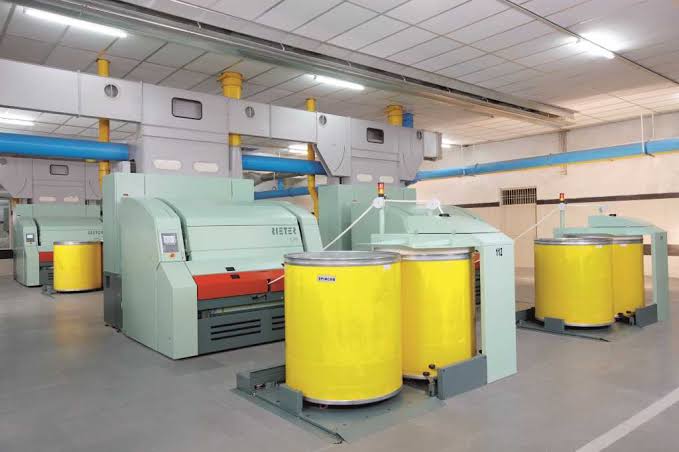
Consistency is the quiet currency of textile manufacturing. Buyers expect the thousandth metre of fabric to look like the first, and that expectation starts much earlier than weaving or knitting. It starts with the sliver. As quality demands have risen, the technology built into the drawing frame machine has changed considerably, giving mills better tools for controlling variation and using their time and materials more efficiently.
Why Consistency Is So Demanding
Natural fibres vary from bale to bale, and even synthetic staple fibre shows small differences between lots. Carding adds its own variations, and these combine into a sliver that is never perfectly uniform. The drawing stage is where much of that variation can be reduced, so any improvement in how the machine senses and corrects it has a direct effect on everything downstream.
Autolevelling: Correcting Variation as It Happens
Perhaps the most significant technological development is the autoleveller. These systems measure the thickness of the incoming or outgoing sliver and adjust the draft accordingly, so that heavy sections are drawn out more and light sections less. Two broad approaches exist. Open-loop systems measure the sliver before drafting and correct in advance. Closed-loop systems measure the sliver after drafting and feed the result back into the control. Some designs combine elements of both.
Because the machine reacts continuously, it can correct variations that manual settings could never anticipate. This is especially valuable in long production runs, where small deviations would otherwise accumulate.
Drive Systems and Digital Control
Older machines relied on gears and mechanical change points to set the draft. Many modern machines use individually controlled drives with digital settings. This makes it faster to change from one product to another, reduces the likelihood of setting errors, and makes it easier to repeat a proven set of parameters. Digital displays also give operators a clearer view of production speed, draft, and any fault conditions.
Monitoring, Stop Motions, and Quality Data
Sensors have become more capable. Stop motions detect sliver breaks, missing slivers, or roller laps and halt the machine before faults spread. Many machines can also record quality data such as sliver evenness trends, so that quality teams can identify patterns and intervene early. This turns quality control from a periodic inspection into a continuous process.
Efficiency Beyond Speed
It is tempting to equate efficiency with higher delivery speeds, and speeds have indeed increased over the decades. In practice, efficiency covers more than speed. Reduced stoppages, faster product changes, less material waste, and fewer quality complaints all contribute. Features such as automatic can changing and optimized handling of full cans reduce manual intervention and keep the machine producing for longer.
Energy use is also receiving more attention. Efficient drive systems and sensible control of auxiliary functions can lower consumption without affecting output.
Material efficiency deserves a mention as well. Better levelling means fewer rejected cans, less rework, and lower waste further down the line.
Technology Is Only as Good as the Settings Behind It
Advanced controls do not remove the need for process knowledge. Draft ratios, roller settings, and pressures still need to suit the fibre, and a poorly chosen setting will be faithfully reproduced by a very precise machine. Operators and technicians remain central to good results, and training should keep pace with the equipment.
Choosing Technology Wisely
More features do not automatically mean better results. Before investing, mills should ask which problems they are actually trying to solve: high count variation, long changeover times, limited quality data, or labour-intensive handling. Matching the technology to the real bottleneck produces better returns than buying the most advanced specification on the market.
Validating Processes at Laboratory Scale
Before a new fibre or blend is introduced to production, many organizations test its drafting behaviour on a small scale. A laboratory drawing frame machine can support this stage by letting technical teams examine how a material drafts and what kind of sliver it produces, so that sensible starting conditions can be proposed for the production line. The findings still need to be confirmed on full-scale equipment, but early insight reduces the number of costly trial runs.
Quality Control Remains Essential
Whatever technology is installed, verification remains necessary. Regular sliver weight checks, evenness testing, and inspection of roller coverings confirm that the machine is performing as intended. Preventive maintenance, including timely replacement of worn parts, protects the accuracy of sensors and drives as much as it protects the mechanics.
Looking Ahead
Textile processing is moving steadily toward greater use of data. As sensors, connectivity, and analysis tools mature, the drawing frame is likely to become an even richer source of information about fibre behaviour and process stability. Mills that learn to read and act on this information will be better placed to meet customer expectations for uniform, dependable products.
In short, drawing frame technology serves a simple goal: making each metre of sliver closely match the last. Mills that pair modern equipment with solid process knowledge are best equipped to reach it.