The optical networking hardware market reached $23 billion in 2025, growing 50 percent year over year, and the volume driving that growth is overwhelmingly 400G and 800G. Yet walk into most mid-market data centers or ISP aggregation sites today, and you will still find 100G QSFP28 modules doing the heavy lifting. The 100G QSFP28 optical transceiver remains the workhorse standard for spine-leaf fabrics, ISP aggregation layers, and enterprise core links — not a transitional speed on its way out. Understanding where this technology stands, how it continues to evolve, and how to deploy it intelligently matters for any network team planning capacity upgrades.
The Evolving 100G QSFP28 Landscape
When IEEE ratified 802.3bm in 2015, the QSFP28 form factor solved a practical problem: delivering 100G throughput through four aggregated 25G electrical lanes while fitting the same cage footprint as QSFP+. That backward compatibility meant switches already populated with 40G ports could upgrade to 100G without replacing the physical infrastructure — no cage swap, no rewiring at the chassis level.
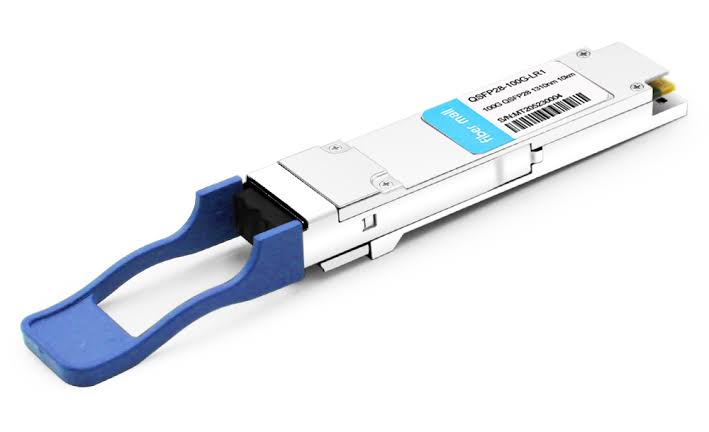
A decade later, the ecosystem around 100G QSFP28 modules has matured considerably. The early intensity-modulated modules relied on a 4x25G NRZ scheme with multiple channels and relatively complex manufacturing processes. More recently, the industry has moved toward single-channel 100G solutions using PAM4 technology and 50GBaud optoelectronic chips, simplifying packaging and reducing costs. For 10km reaches, single-channel 100G QSFP28 LR1 modules with integrated DSP chips have entered the market, broadening deployment options beyond the classic four-lane architecture.
Market data reinforces QSFP28’s staying power. The global 100G QSFP28 SR4 optical module market alone was valued at approximately $452 million in 2024 and is projected to reach $727 million by 2031, growing at a 6.9% CAGR. Meanwhile, 100G optical module shipments surpassed 42 million units globally in 2025, with data center interconnect and 5G fronthaul/backhaul remaining the primary demand engines.
SR4 vs. LR4: Choosing the Right Optic for Your Fiber Plant
The most consequential decision when deploying 100G QSFP28 optics is not which vendor to buy from — it is whether your application calls for SR4 or LR4, and that choice hinges almost entirely on your existing cabling infrastructure.
The 100GBASE-SR4 QSFP28 operates at 850nm across four parallel 25G lanes over multimode fiber, using an MPO-12 connector. Reach tops out at 70 meters over OM3 fiber and 100 meters over OM4. Power draw is modest, typically under 3.5W, and SR4 modules are the lowest-cost 100G QSFP28 variant. These characteristics make 100G SR4 the default choice for intra-data-center links: top-of-rack to spine, server to leaf, row-to-row connections where fiber runs stay inside a single building.
LR4 takes a different approach. Operating at 1310nm over single-mode fiber with LC duplex connectors, it reaches up to 10km using a CWDM-like wavelength scheme. LR4 costs more and draws more power, but it solves the distance problem SR4 cannot touch. For campus interconnects, inter-building links, or any path exceeding 100 meters, LR4 is the correct answer.
The critical deployment lesson: these two variants are not interchangeable at the cabling layer. SR4 requires MPO/MTP trunk cabling and multimode fiber; LR4 requires LC duplex and single-mode fiber. If your existing plant is LC-based single-mode, SR4 forces a fiber infrastructure change — and that cost needs to go into your calculation before you commit. Conversely, if you have OM4 and your link is within 100 meters, SR4 provides a straightforward way to deploy 100G without paying for single-mode optics you do not need.
Deployment Best Practices and Practical Pitfalls
Deploying 100G QSFP28 optical transceivers successfully requires attention to details that datasheets don’t always cover. Three areas consistently trip up network teams.
Fiber polarity and connector integrity. SR4 uses an MPO interface, so the module, trunk cable, and patching must use a compatible polarity method. In SR4-heavy zones, use OM4 fiber with tight bend-radius cables and dedicated trunk pathways to preserve the eight-lane integrity. Label each QSFP28 module with the exact fiber path it serves — post-deployment troubleshooting without accurate labeling becomes frustrating and error-prone.
Thermal budgeting. While SR4 modules draw less than 3.5W, that heat still matters in high-density switch line cards. When a QSFP28 module generates 5 watts of heat, the difference between a properly designed heat sink and a vented cage can mean the difference between stable operation at the MSA-specified 70°C case temperature and packet drops at 82.5°C. Map port-bank temperatures during peak load and adjust airflow management accordingly.
Breakout flexibility. One 100G QSFP28 port can split into four 25G SFP28 connections via a breakout DAC or AOC, which is useful for ToR-to-server links in high-density racks. This breakout capability extends the useful life of 100G ports considerably, allowing operators to serve 25G leaf connections from the same hardware they will later use for 100G uplinks.
The Road Ahead: QSFP28’s Place in a 400G World
No major platform vendor has issued a formal end-of-sale notice for QSFP28 ports as a product class. Cisco, Juniper, Arista, and Huawei all continue to sell and support QSFP28-based line cards. What has changed is the economics: as 400G QSFP-DD transceivers scale with AI infrastructure demand, per-bit costs on 400G ports are approaching 100G levels. When that crossover happens for new deployments, the calculus shifts.
For existing QSFP28 infrastructure, “end of life” is better understood as a planning horizon than a fixed date. The practical approach for most operators is to extend where the fiber plant and port count justify it, replace in kind where the deployment is recent and working well, and plan a stepping-stone migration to 400G for high-traffic spine links. The QSFP28 investment already made does not need to be stranded — it needs to be deployed where it still makes economic sense, with clear-eyed awareness of when and where the next upgrade will be required.
For network engineers and procurement teams, the takeaway is straightforward: 100G QSFP28 remains a reliable, cost-effective, and widely supported technology for the vast majority of data center and ISP applications in 2026. Choose SR4 for short multimode runs within the data center, LR4 for single-mode links that cross buildings or campuses, validate your cabling plant before ordering optics, and keep an eye on 400G pricing as the long-term migration target.