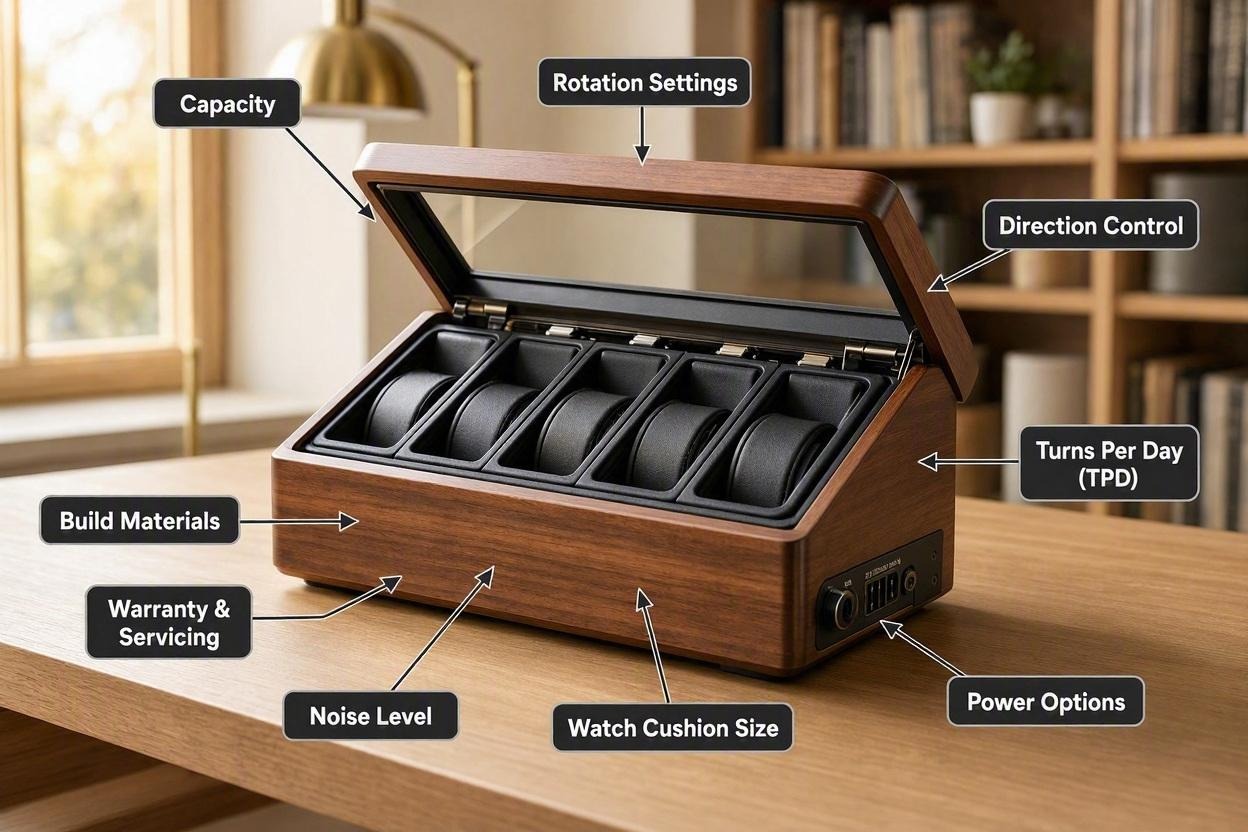
A second automatic watch changes how you live with your collection. You wear one piece on Monday, another on Tuesday, and by Friday two of them have stopped, the date is wrong, and you spend ten minutes resetting a perpetual calendar you would rather leave alone. A multi watch winder solves that problem, but only when you choose one that fits your watches, your space, and the way you rotate them.
The quick answer: pick a winder with enough slots for every automatic watch you own, adjustable turns per day and rotation direction, cushions that fit your case sizes, and a motor quiet enough for the room where it will sit. The nine checks below walk you through each decision in the order that matters.
1. Count Which Watches Actually Need Winding
Not every watch in your collection needs a winder. Quartz watches run on a battery, and manual-wind watches only move when you turn the crown, so neither benefits from a rotating cradle. Only automatic watches, which wind themselves through wrist motion, belong in a winder. If you want a refresher on how the rotor and mainspring work together, this overview of how automatic movements work explains the mechanism clearly.
Start by laying out your collection and sorting it into three groups:
- Daily-wear automatics that you rotate through every week
- Complicated automatics, such as perpetual calendars, moon phases, and annual calendars, which take the longest to reset
- Non-winding pieces, such as quartz, manual-wind, or solar watches
Winders earn their keep with the second group. A simple time-and-date watch takes thirty seconds to reset, while a perpetual calendar can take several minutes and a careful sequence of pushers. Keep those watches moving and you never touch the calendar settings.
2. Match the Turns Per Day and Rotation Direction
Turns per day (TPD) tells you how many rotations the winder completes in 24 hours. Most automatic watches need somewhere between 650 and 900 turns per day to stay fully wound, but the exact figure varies by movement. Some watches need very few turns, and a few need more. Give the watch too little motion and it stops. Give it far too much and you add unnecessary wear on the winder’s motor without any benefit to the watch.
Rotation direction matters just as much. Some movements wind in one direction only, others wind both ways, and some perform best with a bidirectional setting that alternates. Your watch’s manual or the manufacturer’s support page usually states the recommended TPD and direction. If you cannot find those figures for a specific movement, ask the team at Aevitas before you buy, so you can set each slot correctly from the first day.
A good multi watch winder lets you program each slot separately. That flexibility matters when your Rolex, your Seiko, and your Swiss chronograph all want slightly different settings.
3. Choose the Right Number of Slots, and Plan for Growth
Buy for the collection you will own in two years, not just the one you own today. Most collectors add watches faster than they expect. A four-slot winder feels generous when you own three automatics, then feels tight after one anniversary gift and one impulse purchase.
Think about slot count in terms of your habits:
- Two to three watches: A compact dual or triple winder keeps your daily rotation running without taking up much room.
- Four to six watches: This range suits most enthusiasts and leaves space for one or two additions.
- Seven or more: A larger cabinet-style unit makes sense, especially if you also want storage for non-winding pieces.
Some cabinets pair winding slots with static display trays, so your quartz watches and dress watches sit alongside your automatics. If you are comparing configurations, browse our range of multi watch winders to see how different slot counts and layouts suit different collections.
4. Check That the Cushions and Cuffs Fit Your Case Sizes
A watch that slips or tilts inside its cushion will not wind properly and can rub against the housing. Cushion fit deserves more attention than most buyers give it.
Measure your widest and thickest watch before you shop. A 45mm dive watch on a bracelet needs a very different setup from a slim 36mm dress watch on a leather strap. Look for adjustable cushions that hold the watch snugly without squeezing the case or bracelet.
Metal bracelets add weight, and heavy watches put more load on the motor. Check that the winder handles your heaviest piece comfortably, especially if you own large steel or gold models.
5. Put a Quiet Motor Near the Top of Your List
Motor noise decides whether you keep a winder in your bedroom or banish it to a spare room. A low hum that sounds fine in a showroom can become an irritation at 2 a.m., so think about where the winder will live before you commit.
Brushless motors generally run more quietly and last longer than brushed alternatives. Rubber or felt dampening inside the housing also reduces vibration, particularly on wooden surfaces. If you plan to place the winder in a bedroom, home office, or living area, treat silent operation as a requirement rather than a bonus.
6. Understand the Power Source and Rest Cycles
Most winders run on mains power, batteries, or both. Mains power suits a permanent home. Battery backup protects your setup during a power cut, and a battery-only model works well if you want to move the winder between rooms or travel.
Rest cycles matter too. A winder does not spin nonstop. It runs for a period, pauses, then repeats, which mirrors natural wrist movement and keeps the motor from running continuously. You can safely leave a well-designed winder running all day, because modern automatic watches include a slipping clutch that prevents overwinding.
7. Decide Where the Winder Will Live
Location affects both performance and safety. Keep your winder away from strong magnetic fields, because magnets can disturb the accuracy of mechanical movements. Speakers, laptops, tablets, and magnetic clasps all count as sources to avoid.
Avoid direct sunlight as well. UV exposure fades dials and can dry lubricants faster than shade does. A stable indoor spot with moderate temperature and low humidity gives your watches the best environment.
If you want the winder inside a wardrobe or a safe, check the dimensions and the power cable route first. Some collectors prefer a display piece on a dresser, while others tuck the winder away and take out their daily wear each morning. Either approach works, so long as the location suits the winder’s noise level and footprint.
8. Inspect Materials, Glass, and Security
A winder holds watches worth hundreds or thousands of pounds, so build quality matters as much as looks. Check the finish inside and out. Soft, non-abrasive lining protects crystals and cases from scratches. A clear glass or acrylic front lets you admire the collection while keeping dust away.
Look closely at the locking mechanism. A keyed lock will not stop a determined thief, but it keeps curious children and visitors from handling your watches. If you own high-value pieces, pair the winder with proper insurance and consider a separate safe for long-term storage.
Wood, leather, and carbon-fibre finishes all suit different rooms. Choose one that matches your furniture and personal taste, because you will see it every day.
9. Balance Your Budget Against Long-Term Value
A cheap winder costs more in the long run if the motor fails or the cushions scratch your cases. You do not need to buy the most expensive option, but you should avoid the lowest price on the shelf.
Compare warranty length, motor quality, programmability, and materials rather than looking at the price tag alone. A winder that protects three or four valuable watches for a decade delivers far better value than a bargain unit you replace within two years.
If you want an independent starting point, our guide to Shop Aevitas Top 7 Best Watch Winders compares leading options side by side, so you can see how features and price levels stack up before you decide.
Final Thoughts
A multi watch winder works best when it matches your collection rather than the other way around. Count your automatics, check each movement’s turns per day and rotation direction, measure your cases, and think honestly about noise and placement. Those four steps eliminate most bad purchases before they happen.
Once your winder is running, your watches wait for you fully wound, with the date and calendar functions correct. You spend less time resetting and more time wearing what you love. Choose a well-built unit with room to grow, and it will serve your collection for years.
FAQs
Do automatic watches really need a watch winder?
No, but a winder helps in many situations. An automatic watch that sits unworn for a few days will stop once its power reserve runs down, and you will need to reset the time and date. A winder keeps the watch running, which makes the most difference for perpetual calendars, moon phases, and other complicated pieces.
Can a watch winder overwind or damage an automatic watch?
A quality winder will not damage your watch. Modern automatic movements include a slipping clutch or bridle that stops the mainspring from overwinding. Problems usually come from very poor motors, incorrect settings, or ill-fitting cushions rather than from the winding itself.
How many turns per day does an automatic watch need?
Most automatic watches need between 650 and 900 turns per day, though the exact figure depends on the movement. Check your watch’s manual or the manufacturer’s website for the recommended TPD, and set each slot accordingly.
Should I leave my watch in the winder all the time?
You can, but you do not have to. A winder with rest cycles suits daily wear and keeps the watch ready to go. If you rarely wear a particular watch, some collectors prefer to store it in a static tray and wind it occasionally, which reduces long-term motor use.
Can I put different brands of watches in the same multi watch winder?
Yes. A programmable multi watch winder lets you set a different TPD and rotation direction for every slot, so a Rolex, an Omega, and a Seiko can sit side by side with correct settings for each.
Is it safe to keep a watch winder in the bedroom?
It is safe, provided the winder has a quiet motor and sits away from magnetic sources such as speakers or phones. Choose a brushless motor with good dampening, and place it on a stable surface so vibration does not carry.