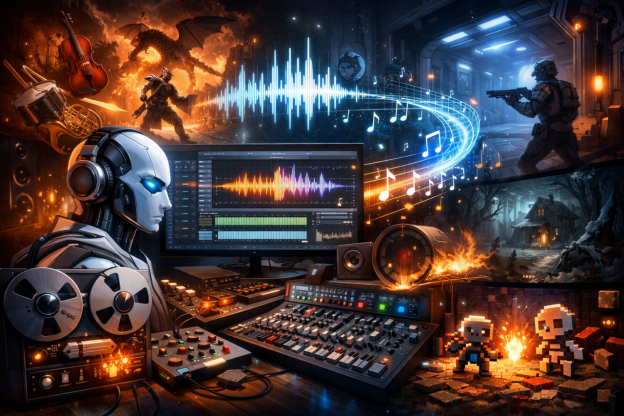
For decades, game development has been a balancing act between ambition and resources. Nowhere is this more apparent than in audio production. Creating a truly immersive soundscape, from the sweeping orchestral score of a fantasy RPG to the crunchy, visceral footsteps in a survival horror, traditionally requires expensive recording sessions, vast libraries of licensed assets, or the meticulous work of foley artists.
But the landscape is shifting. Generative AI is rapidly transforming how we think about, create, and implement sound in video games. This isn’t just about reusing existing samples or automating volume levels. We are entering an era where AI synthesises entirely new audio assets from scratch, tailoring them to specific game states in a matter of seconds.
For indie developers and seasoned sound designers alike, this AI game development technology represents a massive leap forward. It offers a way to generate high-quality, bespoke audio without the Hollywood budget, turning a weeks-long process into an afternoon of creative exploration.
How Generative AI Audio Works
To understand the power of an AI sound effects generator, we first need to look at the Fruit Cascade game. It’s easy to dismiss AI as “magic,” but the reality is a fascinating application of deep learning.
Deep Learning Models
At the core of generative audio are sophisticated neural networks. These models are trained on massive datasets containing thousands of hours of sound waves, musical compositions, and Foley recordings. Unlike a traditional synthesiser that uses oscillators to create sound, these models learn the mathematical representations of audio. They understand the waveform structure of a violin’s vibrato, the transient snap of a twig breaking, and the rhythmic complexity of a drum break.
Text-to-Audio and Prompts
The user interface for these complex models is often surprisingly simple: text. Just as image generators use text prompts to create visuals, AI game audio tools use natural language processing to interpret requests.
A developer might type, “heavy metallic door slamming in a cavernous hall, wet reverb.” The AI analyses the semantic meaning of “heavy,” “metallic,” and “cavernous,” correlates them with the patterns it learned during training, and synthesises a new waveform that matches that description. It’s not searching a database for a matching file; it is painting with sound, pixel by pixel—or sample by sample.
Style Transfer
Another powerful capability is style transfer. This allows the AI to take a simple input like a hummed melody or a basic rhythmic tapping and render it in the style of a specific instrument or genre. A developer could tap out a rhythm on their desk, record it, and have the AI transform that rhythmic data into a cinematic war drum sequence or a chiptune melody, bypassing the need for physical instruments entirely.
The Benefits of Game Development
The integration of generative AI music and sound effects into game engines is solving some of the industry’s most persistent pain points.
Speed and Efficiency
In the fast-paced world of game jams and agile development, speed is currency. Traditional audio workflows often involve searching through gigabytes of stock libraries to find a sound that is “close enough,” and then spending hours layering and processing it to fit the game. AI tools allow for real-time prototyping. A sound designer can generate ten variations of a laser blast in seconds, pick the best one, and drop it directly into the engine.
Dynamic and Adaptive Audio
One of the most exciting frontiers is procedural audio for games. Static music tracks often loop predictably, which can break immersion during long play sessions. Generative AI enables adaptive audio that reacts to gameplay in real-time.
Imagine a stealth game where the music doesn’t just fade in and out but evolves in complexity based on the enemy’s proximity. The AI can dynamically adjust the tempo, add percussive layers, or switch the key to build tension, ensuring the soundtrack is always in perfect sync with the player’s actions.
Infinite Variations
Player fatigue is a real issue when it comes to repetitive sound effects. Hearing the exact same recorded sample of a sword hitting a shield for the thousandth time creates a robotic, artificial feeling known as the “machine gun effect.”
Generative AI solves this by creating infinite variations. A developer can generate 50 unique “sword clang” sounds that are statistically similar but distinct in their waveform. When implemented in the game, the engine can cycle through these variations randomly, keeping the audio experience fresh and organic.
Cost-Effectiveness
For indie developers, budget constraints often mean sacrificing audio quality. Hiring a full orchestra is out of reach for most small studios. AI democratizes access to high-end audio, allowing small teams to produce soundscapes that rival triple-A productions. It frees up the budget to be spent on other critical areas like art, narrative, or gameplay mechanics.
Addressing the “Human Element”
With all this talk of automation, it is natural to worry about the role of the human artist. However, the most successful implementations of AI in creative fields view the technology as a collaborator, not a replacement.
AI is excellent at the heavy lifting, generating raw materials, and handling repetitive tasks. But it lacks intent. It doesn’t understand why a scene needs to feel melancholic or why a sound effect needs to be punchy rather than realistic.
This is where the sound designer becomes more important than ever. The role shifts from “creator of raw sounds” to “curator and director.” The human ear is still required to mix the audio, implement it with emotional intelligence, and ensure it serves the narrative.
Furthermore, ethical considerations are paramount. Developers must be mindful of the tools they use, opting for platforms trained on ethically sourced or public domain data to respect the rights of original artists.
The Future of Immersion
Generative AI is not just a new tool in the toolbox; it is a new way of building worlds. By removing the technical barriers to high-quality audio, we empower developers to create deeper, more immersive experiences.
From adaptive soundtracks that evolve with the narrative to infinite variations of environmental foley, the potential for AI game audio is limitless. The technology is here, it is accessible, and it is ready to change the way we listen to games.
Keep an eye for more latest news & updates on Technorozen!